Lithium vs. Lead-Acid Golf Cart Batteries: What Buyers Should Know
Compare battery chemistry, charging, maintenance, weight, usable capacity, replacement considerations, and compatibility before choosing an electric golf cart.
The battery is one of the most important components of an electric golf cart. It supplies the energy needed to operate the motor and influences charging, usable travel distance, maintenance, and long-term ownership costs.
When comparing electric golf carts, buyers often encounter two broad battery categories: lead-acid and lithium-based systems. Both can power golf carts, but they differ in design, operating characteristics, and maintenance requirements.
The choice is not simply about selecting the battery with the most attractive advertised feature. The installed system must be compatible with the cart, charger, electrical components, and intended operating conditions.
At Bennett’s Golfcarts , customers can browse available vehicles through our online shop and review the specifications provided for each product. This guide explains the main differences between lithium and lead-acid batteries so you can ask informed questions before purchasing.
Lithium-based batteries can offer advantages in weight, maintenance, and usable-energy characteristics, depending on the system. Lead-acid batteries are an established option with different initial-cost and maintenance considerations. The appropriate choice depends on your cart’s compatibility, expected use, budget, charging equipment, and the actual battery specifications.
1. How Do Electric Golf Cart Batteries Work?
An electric golf cart uses stored electrical energy to power its motor. The battery supplies energy through the vehicle’s electrical and control systems. When the battery requires replenishment, it is connected to a suitable charging system.
Battery systems are specified using several measurements, including voltage, capacity, and energy. These values help describe the system, but they do not independently establish how far a particular cart will travel.
Voltage
Voltage is one electrical characteristic of a battery system. Golf carts are designed around particular electrical requirements, so replacement batteries must be compatible with the vehicle.
Capacity
Battery capacity is commonly expressed in ampere-hours. The usable amount depends on battery design, operating conditions, and other factors.
Energy
Energy capacity may be expressed in watt-hours or kilowatt-hours. Comparing energy figures can provide additional context, but battery chemistry and usable operating limits still matter.
Always use the manufacturer’s documentation when interpreting the specifications of a particular battery system.
2. What Are Lead-Acid Golf Cart Batteries?
Lead-acid batteries have been used in electric vehicles and other applications for many years. They are an established battery option in the golf cart market.
The term “lead-acid” describes a broad family of batteries rather than one identical product. Different designs may have different maintenance and charging requirements.
Flooded lead-acid batteries
Flooded batteries are one lead-acid design. Depending on the manufacturer’s instructions, they may require routine inspection and maintenance by an appropriately qualified person.
Their care requirements should not be applied automatically to other battery designs.
Sealed lead-acid batteries
Some lead-acid systems use sealed designs, including certain absorbent glass mat configurations. Their maintenance requirements differ from those of flooded batteries.
Why battery type matters
If a product listing identifies a cart only as having “lead-acid batteries,” ask for the specific battery information when it is important to your purchase.
Battery design, condition, and compatible charging equipment can all influence the ownership experience.
3. What Are Lithium Golf Cart Batteries?
Lithium-based batteries use a different electrochemical system from lead-acid batteries. Lithium-ion is a broad category containing multiple chemistries and battery designs.
Some golf cart systems use lithium iron phosphate, often abbreviated as LFP or LiFePO4. Other lithium-based designs also exist.
Do not assume that every battery described as “lithium” has identical specifications, safety characteristics, or operating limits.
Battery management systems
Lithium battery assemblies commonly incorporate battery management electronics. Their functions depend on the specific system and manufacturer.
These components form part of the overall battery design. Compatibility with the vehicle and charger remains important.
Weight considerations
Some lithium-based systems can provide a weight advantage compared with lead-acid systems designed for similar applications.
However, the actual difference depends on battery capacity, enclosure, design, and installation.
Maintenance considerations
Lithium-based systems generally have different maintenance requirements from flooded lead-acid batteries. This does not mean they require no inspection or care.
Owners should follow the manufacturer’s charging, storage, and operating instructions.
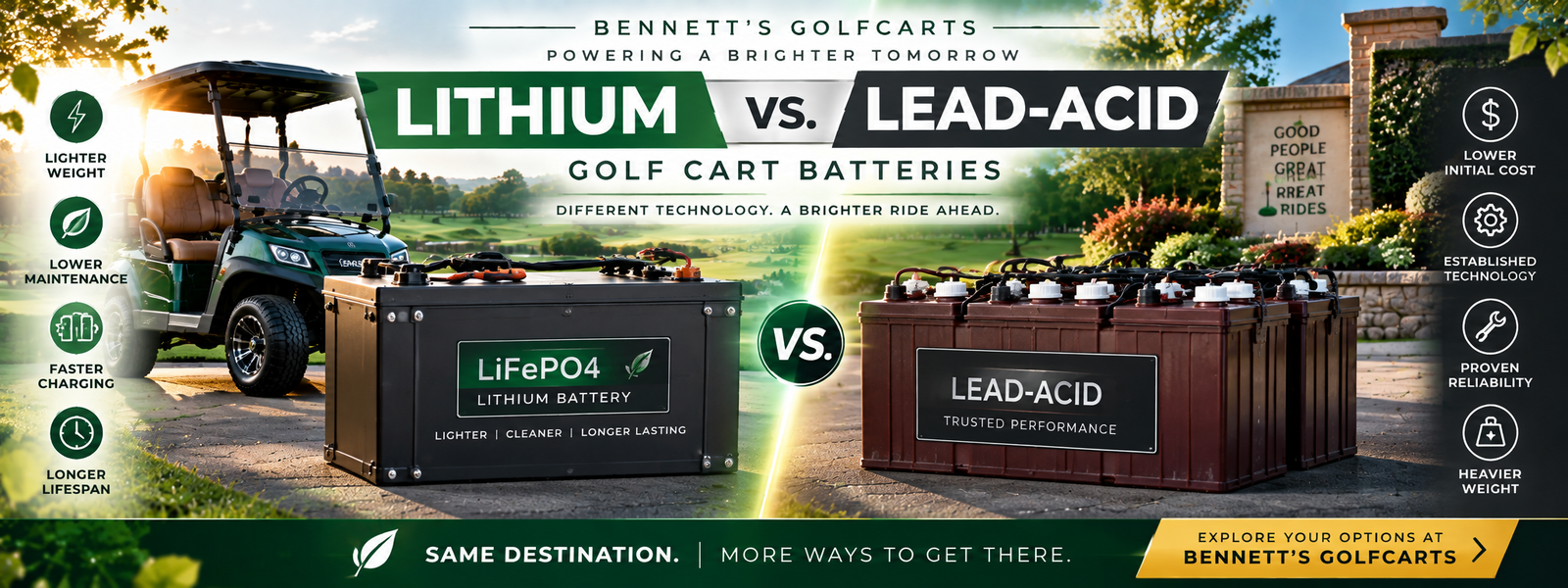
4. Lithium vs. Lead-Acid: Side-by-Side Comparison
The following table summarizes general differences. It should not replace a comparison of actual battery specifications.
| Consideration | Lead-acid | Lithium-based |
|---|---|---|
| Battery design | Established chemistry with multiple configurations. | Broad family with different chemistries and designs. |
| Weight | Often heavier for comparable usable-energy applications. | May offer lower weight, depending on the system. |
| Maintenance | Depends on design; flooded types may require more routine attention. | Different maintenance needs; follow system instructions. |
| Charging | Requires compatible lead-acid charging. | Requires compatible charging and management electronics. |
| Usable capacity | Depends on battery design, discharge conditions, and operating limits. | May offer different usable capacity characteristics, depending on the system. |
| Initial cost | Compare actual purchase and installation quotations. | May involve a higher initial cost, depending on configuration. |
| Compatibility | Must match vehicle and charger. | Must match vehicle, charger, and relevant electronics. |
| Used-cart evaluation | Check age, condition, maintenance, and charging. | Check condition, compatibility, and system documentation. |
For broader battery technology information, consult the U.S. Department of Energy . For an individual golf cart, prioritize the specifications supplied by the vehicle and battery manufacturers.
5. Does Lithium Give a Golf Cart More Range?
A lithium-based battery system may provide different usable-energy characteristics from a lead-acid system. However, the word “lithium” alone does not establish a particular travel distance.
Range depends on the actual energy available, vehicle efficiency, passenger and cargo load, terrain, tire characteristics, temperature, and driving pattern.
Compare actual energy capacity
Two battery systems with different capacities should not be compared solely by chemistry. Review the manufacturer’s stated specifications and operating limits.
Consider passenger load
Carrying more passengers increases the load on the vehicle. Energy consumption may differ under otherwise similar conditions.
Consider terrain
Operating on hilly terrain can create different energy demands from operating on relatively level ground.
Review battery condition
A used battery may not perform like a new battery of the same model. Ask about available condition information before purchasing a used electric golf cart.
If a listing provides a range estimate, find out whether it is based on manufacturer data or another disclosed method.
6. Charging: What Changes Between Battery Types?
Charging requirements are specific to the battery system. A charger suitable for one chemistry or configuration should not be assumed suitable for another.
Charger compatibility
Confirm that the charger supplied with the cart is compatible with the installed battery system. This is especially important when reviewing a cart that has undergone a battery conversion.
Charging time
Charging time depends on battery capacity, state of charge, charger output, battery design, and operating conditions.
Some lithium-based systems support different charging characteristics from lead-acid systems, but actual charging time must be confirmed for the specific equipment.
Charging location
Consider where the cart will be charged. The location should meet the manufacturer’s requirements for electrical supply, ventilation where applicable, and environmental conditions.
Charging during storage
Extended storage can involve different charging recommendations depending on the battery chemistry and system design.
Follow the manufacturer’s instructions rather than applying one general procedure to every battery.
Charging safety: Do not use an incompatible charger, bypass battery-management electronics, or modify battery wiring. Battery systems can present serious hazards. Obtain qualified assistance for installation, diagnosis, or conversion.
7. Battery Lifespan: What Buyers Should Understand
Battery lifespan is influenced by more than chemistry. Design, operating conditions, charging, storage, maintenance, and usage patterns can all affect long-term performance.
Manufacturers may describe battery performance using cycle-life figures or other measurements. These figures are generally associated with particular test conditions and should not be interpreted as a guaranteed number of years for every owner.
Cycle life
A cycle-life specification describes battery performance under defined cycling conditions. It is not the same as a fixed calendar lifespan.
Storage and temperature
Environmental conditions can influence battery performance and aging. Follow the applicable storage recommendations for the installed system.
Maintenance history
When buying a used cart, ask about battery age, charging performance, and available maintenance information.
A clean exterior does not establish battery condition.
Warranty terms
Battery warranties, where applicable, vary by product and manufacturer. Review the actual warranty terms rather than assuming a particular duration or level of coverage.
See the Bennett’s Warranty Policy and the information provided for the specific product.
8. Maintenance Requirements Compared
Battery maintenance is one of the most important ownership differences between certain lead-acid and lithium-based systems.
Flooded lead-acid maintenance
Flooded lead-acid systems may require routine procedures specified by the manufacturer. These can involve tasks that should be performed only by someone with the appropriate knowledge and protective equipment.
Sealed lead-acid maintenance
Sealed designs have different care requirements. Do not apply procedures intended for flooded batteries to sealed products.
Lithium-system maintenance
Lithium-based systems generally do not have the same routine maintenance procedures as flooded lead-acid batteries. However, owners must still follow instructions for charging, inspection, storage, and operation.
Whole-vehicle maintenance
Choosing lithium does not eliminate the maintenance needs of the rest of the golf cart. Tires, brakes, steering, suspension, and other components still require appropriate attention.
9. Comparing Initial Cost and Long-Term Ownership
Battery cost should be evaluated as part of the complete ownership picture. Initial purchase price, compatibility, installation, charging equipment, maintenance, and replacement considerations may all matter.
Initial purchase price
Some lithium-based systems may involve a higher initial purchase cost than certain lead-acid alternatives. However, pricing varies by capacity, design, brand, and included equipment.
Installation and compatibility
A battery replacement or conversion may involve additional components or professional work. Do not compare battery prices without considering the complete compatible system.
Maintenance
Different maintenance requirements may affect the time and expense associated with ownership.
Future replacement
Replacement costs depend on the battery type, required capacity, and compatible products available when replacement becomes necessary.
| Cost category | What to confirm |
|---|---|
| Battery purchase | Actual model, capacity, and quoted price. |
| Installation | Compatibility and any required professional work. |
| Charging equipment | Whether a compatible charger is included. |
| Maintenance | Manufacturer-specific care requirements. |
| Replacement | Compatible options and future costs. |
| Warranty | Actual coverage, exclusions, and duration. |
When comparing complete carts, review the full checkout total and the equipment included in the listing.
10. Can You Convert a Lead-Acid Golf Cart to Lithium?
Some golf carts may support a compatible lithium conversion, but this depends on the specific vehicle and battery system.
A conversion should not be treated as a simple battery swap without confirming the relevant electrical and mechanical requirements.
Vehicle compatibility
The replacement system must be appropriate for the cart’s electrical design and operating requirements.
Charging compatibility
The charging equipment must be suitable for the replacement battery. Do not assume an existing charger is compatible.
Physical installation
Battery dimensions, mounting, and other installation considerations may differ between systems.
Warranty and documentation
Modifications may affect applicable product or manufacturer warranty terms. Review the documentation before authorizing any work.
Important: Battery conversion involves electrical-system compatibility and safety considerations. Consult the relevant manufacturer and a qualified technician. Do not attempt an unsupported conversion.
11. Evaluating Batteries in Used Golf Carts
If you’re comparing used electric golf carts, battery condition deserves particular attention. The installed battery may differ from the system originally supplied with the cart.
Ask whether the battery is original, has been replaced, or is part of a conversion.
Battery identification
Confirm the installed chemistry, model, and available specifications. If the listing does not identify the battery, request clarification.
Condition information
Ask about age, maintenance, charging performance, and any available assessment.
Included charger
Confirm whether a compatible charger is included in the purchase.
Disclosed modifications
Ask about known changes to the battery or electrical system.
Read our Product Condition Policy and review the individual listing before ordering.
12. Battery Considerations for Connecticut Golf Cart Owners
Bennett’s Golfcarts is located at 57 Watertown Rd, Morris, CT 06763. Customers researching electric golf carts in Connecticut should consider their expected usage and storage arrangements.
Seasonal weather makes manufacturer storage instructions particularly relevant. Battery systems can have different operating and charging limits under cold conditions.
Winter storage
If a cart will remain unused for an extended period, follow the manufacturer’s storage guidance. Do not apply one battery maintenance procedure to every chemistry.
Charging environment
Confirm that the intended charging location meets the manufacturer’s electrical and environmental requirements.
Choosing a cart
Review available models in the Bennett’s Golfcarts shop . Contact our team if a product’s battery information is unclear.
13. Golf Cart Battery Buying Checklist
Use this checklist when comparing battery systems or evaluating a complete electric golf cart.
- Identify the battery chemistry. Confirm whether the system is lead-acid or lithium-based.
- Review the exact specifications. Check manufacturer information for voltage, capacity, and operating limits.
- Confirm compatibility. Ensure the battery is suitable for the cart.
- Check the charger. Confirm compatible charging equipment.
- Consider intended use. Review expected travel distance, terrain, and passenger load.
- Understand maintenance. Review the manufacturer’s care requirements.
- Evaluate condition. For used batteries, ask about age, maintenance, and available assessment information.
- Compare complete costs. Include installation, charging equipment, and potential replacement needs.
- Review warranty terms. Confirm actual coverage and exclusions.
- Ask unresolved questions. Contact the dealership before purchasing.
14. Frequently Asked Questions
Are lithium golf cart batteries lighter than lead-acid batteries?
Some lithium-based systems can offer a weight advantage for comparable applications. The actual difference depends on battery capacity, design, and installation.
Do lithium golf cart batteries require maintenance?
Lithium systems generally have different maintenance requirements from flooded lead-acid batteries. Owners must still follow the manufacturer’s charging, inspection, and storage instructions.
Does lithium automatically increase golf cart range?
No. Range depends on actual usable energy, vehicle efficiency, load, terrain, battery condition, and driving conditions.
Can I use my existing lead-acid charger with a lithium battery?
Do not assume compatibility. The charger must be appropriate for the installed battery system. Consult the manufacturer and a qualified technician.
How long do golf cart batteries last?
Lifespan varies by chemistry, design, use, charging, storage, and maintenance. Manufacturer cycle-life figures are based on specified conditions and are not guaranteed calendar lifespans.
Can a lead-acid golf cart be converted to lithium?
Some carts may support compatible conversions, but the vehicle, charger, battery, and related systems must be assessed. Obtain qualified assistance before making changes.
Which battery should I look for in a used electric golf cart?
Evaluate the actual installed battery, its condition, compatibility, charging equipment, and available documentation. Chemistry alone does not determine the suitability of a used cart.
Does Bennett’s Golfcarts provide battery warranty coverage?
Warranty coverage, where applicable, depends on the specific product and disclosed terms. Review the product information and Bennett’s Warranty Policy.
15. Choosing the Right Battery for Your Electric Golf Cart
Lithium and lead-acid batteries offer different characteristics, but neither chemistry should be evaluated without considering the complete golf cart system.
Compare battery specifications, charging requirements, maintenance, usable capacity, compatibility, and ownership costs. For a used cart, review battery condition and available documentation.
If you are researching electric golf carts for sale, use the product listing as your starting point and ask about any material detail that remains unclear.
Bennett’s Golfcarts provides an online shop and customer contact options for questions about available products.
Explore Electric Golf Carts at Bennett’s
Browse available golf carts and contact our team if you need clarification about a particular battery configuration, product condition, or delivery arrangement.
Shop Golf Carts → Contact Bennett’s →Further Reading & Customer Resources
For battery-specific operating, charging, and maintenance requirements, consult the documentation supplied by the relevant manufacturer.
- U.S. Department of Energy — general energy and battery technology information.
- U.S. Environmental Protection Agency: Used Household Batteries — battery handling and recycling information; follow applicable guidance for your battery type.
- Club Car — manufacturer product resources.
- Yamaha Golf-Car Company — manufacturer product resources.
- E-Z-GO — manufacturer product resources.
- Bennett’s Product Condition Policy
- Bennett’s Warranty Policy
- Bennett’s Shipping & Delivery Policy
External links are provided for independent research. They do not establish that Bennett’s Golfcarts is an authorized dealer for a particular manufacturer or that any specific battery system is in stock.