4-Seater vs. 6-Seater Golf Carts: Which Configuration Fits Your Needs?
Compare passenger capacity, seating layouts, storage, maneuverability, electric and gas options, and ownership considerations before choosing your next golf cart.
Choosing between a 4-seater and a 6-seater golf cart is about more than the number of passengers. The configuration you select can affect parking space, maneuverability, battery demands, cargo arrangements, and the overall ownership experience.
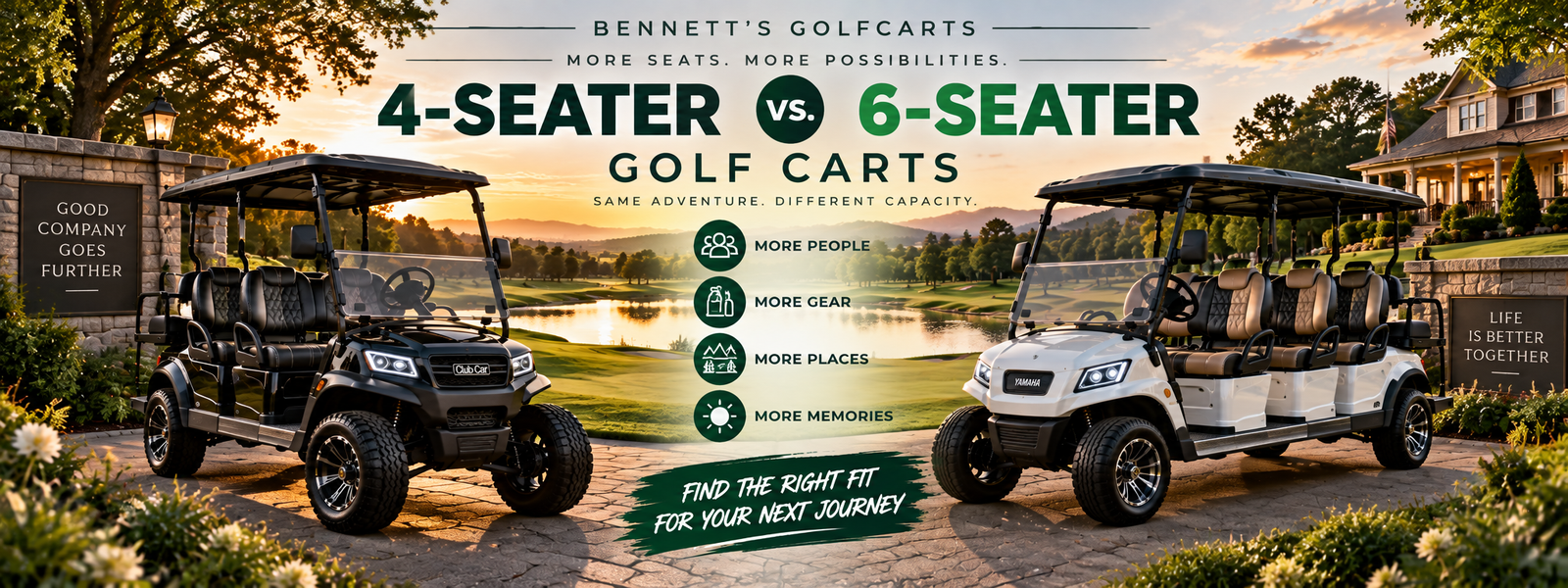
A four-passenger cart may provide sufficient seating for a household or small group. A six-passenger configuration offers additional seating when transporting more people is a regular requirement. However, the most suitable choice depends on the actual model, not simply its advertised passenger count.
At Bennett’s Golfcarts , we encourage customers to review the specifications, condition, and included features of each product before ordering. You can explore current listings in our online golf cart shop .
Choose based on how many passengers you regularly need to carry, available parking and storage space, intended terrain, and your budget. A 4-seater may be sufficient when you typically travel with up to four people. A 6-seater offers more seating for larger groups, but its dimensions, load rating, and operating characteristics must be checked for the specific model.
1. Understanding 4-Seater and 6-Seater Golf Carts
Golf carts are available in multiple passenger configurations. Two common options are four-passenger and six-passenger models. Although their names describe seating capacity, they do not provide a complete picture of the vehicle.
A four-passenger cart may use two forward-facing seats and two rear-facing seats. Other models have a different seating layout. Similarly, six-passenger carts may use multiple forward-facing rows or another arrangement.
These design differences affect passenger access, vehicle length, cargo arrangements, and how occupants enter and exit.
Before comparing two carts, confirm the exact configuration shown in each listing. The manufacturer-rated seating capacity and maximum load should take priority over assumptions based on photographs.
Some models may also offer optional seating or cargo accessories. Do not assume that an accessory can increase the manufacturer’s approved passenger capacity.
2. 4-Seater vs. 6-Seater: Side-by-Side Comparison
The following comparison highlights the practical questions buyers should consider. These are general configuration differences; exact specifications vary by model.
| Feature | 4-Seater Golf Cart | 6-Seater Golf Cart |
|---|---|---|
| Passenger seating | Up to four, subject to rated capacity. | Up to six, subject to rated capacity. |
| Typical use | Smaller groups and households. | Larger groups and passenger transport. |
| Overall dimensions | May be more compact. | May require additional length and parking space. |
| Maneuverability | Depends on wheelbase and steering design. | Check turning radius and access requirements. |
| Battery demand | Depends on vehicle and passenger load. | Additional passengers can increase energy demand. |
| Cargo space | Depends on seating and storage configuration. | Extra seats do not guarantee extra cargo capacity. |
| Purchase price | Compare individual listings. | Compare individual listings and included equipment. |
| Delivery | Confirm freight arrangements. | Confirm dimensions and freight arrangements. |
The key takeaway is that seating capacity is only one specification. Two four-seater models can differ substantially, just as two six-seater models can.
3. When Does a 4-Seater Golf Cart Make Sense?
A four-passenger golf cart may be worth considering when the expected passenger group is relatively small and additional seating would rarely be used.
Everyday personal use
If you usually travel with one, two, or three other people, a four-passenger configuration may provide enough seating. It is important to consider your normal use rather than choosing based on the largest group you might occasionally want to transport.
Parking and storage
Available space can influence your choice. Measure the area where the cart will be stored, including doorway clearance, turning space, and access around the vehicle.
A four-seater is not automatically shorter than every six-seater. Check the actual manufacturer’s dimensions before making a purchase decision.
Seating and cargo flexibility
Some four-passenger carts use rear-facing seating that may incorporate a convertible cargo arrangement. This feature is model-specific and should not be assumed.
If you need both passenger seating and cargo space, confirm whether the cart supports the intended use and observe its rated load limits.
Budget considerations
A smaller passenger configuration may suit buyers who do not need the additional seating of a larger cart. However, the actual price depends on the model, condition, battery, accessories, and other specifications.
Compare complete product listings rather than assuming every four-seater costs less than every six-seater.
4. When Does a 6-Seater Golf Cart Make Sense?
A six-passenger cart may suit situations where transporting more than four people is a regular requirement. The additional seats can reduce the need to divide a group between vehicles, provided the cart is operated within its approved capacity.
Larger passenger groups
If your intended use frequently involves five or six occupants, a properly rated six-passenger cart provides seating designed for that group size.
Consider the accessibility of each row and whether the seating layout is comfortable for the people who will use the cart.
Property and facility use
A six-passenger configuration may be relevant for suitable private properties, recreational facilities, and other environments where larger groups need transportation.
Before purchasing for a business or facility, review the intended operating conditions, insurance considerations, applicable rules, and manufacturer guidance.
Space requirements
Additional seating may increase the vehicle’s overall length. Measure your storage area and assess the paths, entrances, and turning locations where the cart will operate.
A longer vehicle may have different maneuvering characteristics, but the actual turning radius depends on its design.
Passenger load
Carrying additional passengers increases the load placed on the vehicle. Check the manufacturer’s total load rating and the permitted number of occupants.
The availability of six seats does not mean unlimited carrying capacity for additional cargo.
5. Dimensions, Parking, and Maneuverability
Vehicle dimensions deserve careful attention because a cart that meets your seating needs may still be unsuitable for your available space.
Before ordering, measure your garage, storage building, or designated parking area. Include enough room for passengers to enter and exit and for any charging equipment to be used as directed.
Length and width
Check the listed overall length and width, including relevant accessories. A roof, windshield, rear seat, or other equipment may affect practical clearance.
Height clearance
Confirm overall height before using a low garage entrance or covered storage area. Do not estimate height from product photography.
Turning space
Consider the tightest turns the cart will need to make. The manufacturer’s turning specifications can be useful when comparing models for restricted operating areas.
Transport and delivery access
Freight delivery can involve access requirements that differ from those of a small parcel. Review the delivery arrangements before placing an order.
Bennett’s Golfcarts provides more information in its Shipping & Delivery Policy .
6. Electric vs. Gas: Does Seating Capacity Change the Decision?
Both passenger configuration and power source matter when choosing a golf cart. The availability of electric or gas versions depends on the particular product.
Electric golf carts
Electric carts use rechargeable batteries to supply energy to their motors. Owners should consider battery capacity, charging access, battery condition, and the expected operating distance.
A cart carrying more passengers may require more energy under otherwise similar conditions. However, range cannot be determined from passenger count alone.
Battery chemistry, vehicle weight, terrain, driving pattern, and other factors also matter.
Gas-powered golf carts
Gas-powered models use a combustion engine and require suitable fuel and engine-related maintenance. Fuel consumption varies by model, load, terrain, and use.
When comparing four- and six-passenger gas carts, check engine specifications, rated capacity, and manufacturer recommendations.
If you’re considering an electric model, read our available golf cart listings and confirm the exact power source in the product description.
7. Battery Capacity and Range Considerations
Buyers sometimes assume that a six-seater must have a particular battery size or a shorter range than a four-seater. Neither assumption is reliable without model-specific information.
Battery capacity, vehicle efficiency, passenger load, tire characteristics, terrain, and driving conditions all affect electric operation.
Battery chemistry
Electric carts may use lead-acid or lithium-based battery systems. Each requires compatible charging equipment and appropriate care.
Battery chemistry alone does not establish the cart’s usable travel distance.
Passenger load
Additional occupants increase the total weight being transported. This can influence energy consumption, especially when operating on hills or under demanding conditions.
Battery condition
For a used electric cart, ask what is known about battery age, condition, maintenance, and charging performance.
Do not apply a new-cart range specification automatically to a used cart with an older battery.
Questions to ask before buying
- What battery system is installed?
- What charger is included?
- Is the published range a manufacturer estimate?
- What conditions were used to determine that estimate?
- What is known about the installed battery’s condition?
For general energy information, visit the U.S. Department of Energy . For battery-specific operation and maintenance, follow the documentation for the installed system.
8. Passenger Comfort and Seating Layout
Passenger capacity tells you how many occupants a cart is designed to carry. It does not tell you how comfortable a particular seating arrangement will be for every passenger.
Compare the actual seat layout, available legroom, entry and exit arrangements, and any applicable passenger restraints.
Forward-facing and rear-facing seats
Some golf carts include rear-facing passenger seats. Others use multiple forward-facing rows. The preferred layout may depend on the intended use and passenger needs.
Roof coverage
A roof may provide different coverage depending on the vehicle’s length and design. Check the actual product photographs and included equipment.
Entry and exit
Consider how easily passengers can enter and leave each row. This is particularly relevant when the cart will be used by a group with different mobility needs.
If a specific accessibility requirement matters, contact the dealership and review the manufacturer’s information before ordering.
9. Cargo Space, Accessories, and Practical Use
More seats do not automatically mean more usable storage. In some configurations, additional passenger seating occupies space that might otherwise be available for cargo.
If you intend to transport equipment, personal belongings, or other permitted items, inspect the cart’s actual storage arrangements.
Rear-seat configurations
Certain models may offer a rear seat that converts into a cargo platform. This feature is not universal. Confirm whether it is included and follow its rated limits.
Compatible accessories
Accessories may include windshields, covers, enclosures, mirrors, storage components, and other equipment. Compatibility depends on the specific cart.
Before purchasing an accessory, verify the model and configuration it is designed to fit.
Passenger and cargo limits
A vehicle’s total load rating can include passengers and cargo. Do not assume that every seat may be occupied while carrying additional heavy items.
Consult the manufacturer’s operating instructions for the applicable capacity information.
10. Comparing Purchase Price and Ownership Costs
Price is often a major consideration, but a useful comparison should account for more than the advertised amount.
A four-seater with additional equipment may cost more than a different six-seater model. Battery type, condition, brand, and accessories can influence pricing.
Initial purchase cost
Review the exact product price, included features, and applicable checkout charges. Compare products with similar specifications where possible.
Charging or fuel
Electric carts require charging, while gas carts require fuel. The relevant operating cost depends on actual use and local energy prices.
Maintenance
Maintenance needs differ by model and power source. Consider batteries, tires, brakes, mechanical components, and any recommended service procedures.
Battery replacement
For an electric cart, the battery system may represent an important future ownership cost. Check its type, condition, and compatible replacement options.
Delivery charges
Bennett’s Golfcarts uses flat-rate shipping, with the applicable charge displayed at checkout. Review the full order total before completing payment.
| Cost category | What to compare |
|---|---|
| Purchase | Actual model, condition, and included equipment. |
| Delivery | Checkout charge and freight arrangements. |
| Energy | Electricity or fuel for your expected use. |
| Maintenance | Model-specific service requirements. |
| Battery | Condition and potential future replacement. |
| Accessories | Compatibility and optional equipment costs. |
11. Buying a 4-Seater or 6-Seater Golf Cart in Connecticut
Bennett’s Golfcarts is located at 57 Watertown Rd, Morris, CT 06763. Customers researching golf carts in Connecticut can review available products online and contact our team with questions.
When comparing seating configurations, consider where the cart will be used, how many passengers it will carry, and whether your property has sufficient storage and maneuvering space.
Seasonal storage
Connecticut’s seasonal weather makes storage planning relevant. Review the manufacturer’s recommendations for the cart and its battery or fuel system.
Public-road use
A four-seater or six-seater is not automatically permitted on public roads. Requirements depend on the vehicle’s classification, equipment, and applicable state and local rules.
For official vehicle-related information, consult the Connecticut Department of Motor Vehicles .
Product availability
Browse our online shop for current listings. Contact us if you need to confirm a specific seating configuration before purchasing.
12. Shipping and Delivery for Larger Golf Carts
Complete golf carts require delivery arrangements that differ from ordinary small parcels. Bennett’s Golfcarts delivers complete carts by freight carrier.
Standard in-stock orders have an estimated processing time of 1–3 business days. Estimated delivery after dispatch is 3–7 business days, giving a standard overall estimate of 4–10 business days.
These periods are estimates, not guaranteed delivery dates. Pre-orders, special orders, and other circumstances may involve different timing.
Assembly or installation is included with delivery as applicable, but the exact scope varies by product and order arrangements.
Before purchasing a larger cart, confirm the dimensions and delivery arrangements relevant to your location.
Read our Shipping & Delivery Policy for more information.
13. Your Golf Cart Buying Checklist
Use this checklist when comparing four- and six-passenger carts. It helps organize the practical questions that matter before completing an order.
- Confirm passenger needs. How many people will travel regularly?
- Check rated capacity. Review the manufacturer’s passenger and load limits.
- Compare dimensions. Measure parking, storage, and access space.
- Review seating layout. Confirm the arrangement of each row.
- Assess the terrain. Consider the intended operating environment.
- Choose a power source. Compare the available electric or gas configurations.
- Check battery details. For electric models, review chemistry, condition, and charging requirements.
- Consider storage. Check whether passenger seating affects available cargo space.
- Review total costs. Include shipping, maintenance, and relevant accessories.
- Read customer policies. Confirm delivery, return, cancellation, and applicable warranty terms.
If a listing does not answer an important question, contact Bennett’s Golfcarts before placing your order.
14. Frequently Asked Questions
Is a 6-seater golf cart longer than a 4-seater?
A six-passenger configuration may require additional length, but dimensions vary by model. Compare the manufacturer’s actual specifications.
Does a 6-seater golf cart use more battery power?
Carrying additional passengers can increase energy demand, but actual consumption depends on the vehicle, battery, terrain, load, and driving conditions. Compare model-specific information.
Can a 4-seater golf cart carry six people?
No. Do not exceed the manufacturer’s rated passenger capacity. If you need seating for six, consider a properly rated six-passenger configuration.
Is a 4-seater golf cart easier to park?
A more compact model may fit more easily into a smaller space, but compare actual dimensions and turning characteristics.
Are 6-seater golf carts available in electric versions?
Electric six-passenger configurations exist, but availability depends on the product. Check current listings for the exact power source and specifications.
Can I add seats to a 4-seater golf cart?
Some models may support compatible seating accessories. However, an accessory does not automatically change the manufacturer’s approved passenger capacity. Verify compatibility and applicable limits.
Which golf cart is suitable for a larger family?
Consider how many passengers need seating regularly, the manufacturer’s capacity, available storage space, and the intended operating environment.
Does Bennett’s Golfcarts ship complete golf carts?
Yes. Complete golf carts are delivered by freight carrier, subject to applicable product and delivery arrangements. Review the Shipping & Delivery Policy.
What is Bennett’s Golfcarts’ return window?
The standard return window is 14 days from delivery, subject to applicable conditions. Read the complete Refund & Returns Policy before requesting a return.
15. Find the Right Seating Configuration at Bennett’s Golfcarts
A four-seater and a six-seater golf cart can serve different passenger needs, but the number of seats should not be your only consideration.
Compare the manufacturer’s rated capacity, dimensions, seating arrangement, power source, storage options, condition, and ownership requirements. A model that fits your regular use and available space may be more practical than one chosen solely for additional seats.
Bennett’s Golfcarts offers an online shop where customers can review available products. If you have a question about a particular configuration, contact our team before purchasing.
Explore Golf Carts at Bennett’s
Browse our available golf carts and contact us with questions about seating, product details, or delivery.
Shop Golf Carts → Contact Our Team →Further Reading & Customer Resources
For model-specific dimensions, seating capacity, operating instructions, and other specifications, consult the documentation supplied by the relevant manufacturer.
- Club Car — manufacturer product information.
- Yamaha Golf-Car Company — manufacturer product information.
- E-Z-GO — manufacturer product information.
- Connecticut Department of Motor Vehicles — official vehicle-related information.
- Bennett’s Product Condition Policy
- Bennett’s Refund & Returns Policy
- Bennett’s Warranty Policy
Manufacturer links are provided for independent product research. Their inclusion does not establish that Bennett’s Golfcarts is an authorized dealer for any particular manufacturer or that a specific model is in stock.