
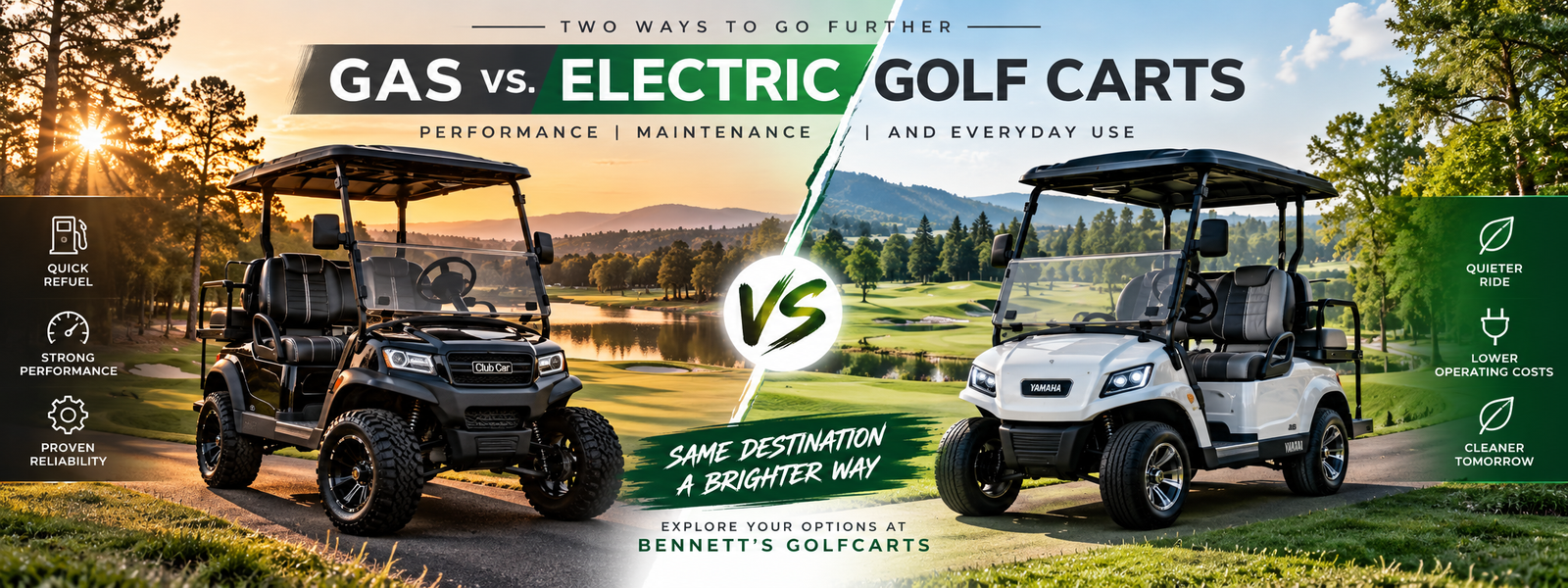
Gas vs. Electric Golf Carts: Performance, Maintenance, and Everyday Use
Compare power sources, charging and refueling, operating costs, passenger capacity, maintenance, and ownership considerations before buying a golf cart.
One of the first decisions when shopping for a golf cart is whether to choose a gas-powered or electric model. Both can serve recreational and practical purposes, but they offer different operating experiences and ownership requirements.
Electric golf carts use rechargeable batteries to power their motors. Gas-powered carts use combustion engines and require fuel. This difference affects how each vehicle is operated, maintained, and prepared for its next use.
However, power source is not the only factor that matters. Two carts using the same type of power may differ in seating capacity, rated load, dimensions, performance, features, and condition. Comparing the actual models is more useful than relying on broad assumptions.
At Bennett’s Golfcarts , customers can explore available vehicles through our online golf cart shop . This guide explains the main differences between gas and electric golf carts and provides practical questions to consider before purchasing.
An electric cart may suit buyers who have convenient charging access and prefer rechargeable operation. A gas cart may suit buyers whose intended use aligns with its fueling and engine characteristics. Compare the actual vehicle’s performance, range or fuel capacity, maintenance requirements, passenger rating, and total ownership cost before making a decision.
1. How Gas and Electric Golf Carts Work
Understanding the basic difference between the two power systems makes it easier to compare product specifications.
Electric golf carts
An electric cart stores energy in a rechargeable battery system. Electrical components control the energy supplied to its motor, which provides propulsion.
When the battery requires charging, the cart must be connected to compatible charging equipment. The charging process and operating limits depend on the installed battery and vehicle design.
Gas-powered golf carts
A gas cart uses a combustion engine to produce power. It requires the fuel specified by its manufacturer and engine-related maintenance.
Its operating characteristics depend on the engine, drivetrain, vehicle configuration, load, and other factors.
Why model specifications matter
The labels “gas” and “electric” describe the power source, not the complete vehicle. Always review the exact model’s specifications.
Manufacturer websites such as Club Car, Yamaha Golf-Car Company, and E-Z-GO provide resources for researching their respective products.
2. Gas vs. Electric Golf Carts: Side-by-Side Comparison
The following table summarizes general ownership differences. Actual performance and costs vary by model and operating conditions.
| Consideration | Electric Golf Cart | Gas Golf Cart |
|---|---|---|
| Power source | Rechargeable battery. | Combustion engine and fuel. |
| Energy replenishment | Compatible charging equipment. | Manufacturer-specified fuel. |
| Propulsion noise | Generally quieter. | Includes engine noise. |
| Routine maintenance | Battery, electrical, and shared vehicle systems. | Engine, fuel system, and shared vehicle systems. |
| Operating distance | Depends on usable battery energy and conditions. | Depends on fuel capacity, consumption, and conditions. |
| Energy cost | Depends on electricity rate and consumption. | Depends on fuel price and consumption. |
| Storage | Requires battery-specific care. | Requires engine and fuel-system guidance. |
| Purchase price | Varies by model, battery, and equipment. | Varies by model, engine, and equipment. |
Neither category guarantees a particular speed, operating distance, or purchase price. Those details must be confirmed for the individual vehicle.
3. Performance: Acceleration, Power, and Terrain
Performance is an important buying consideration, especially when the cart will be used on varying terrain or with different passenger loads.
However, a gas cart is not automatically more capable than every electric cart, and an electric cart is not automatically faster than every gas cart.
Acceleration
Electric motors can provide responsive power delivery, but actual acceleration depends on the motor, controller, gearing, battery system, and load.
Gas-powered models have their own acceleration characteristics, determined by the engine and drivetrain.
Hilly terrain
If you plan to use a cart on hills, compare the manufacturer’s operating recommendations and rated capabilities.
Terrain, passenger weight, tire condition, and other factors influence how a cart performs.
Passenger and cargo loads
Carrying additional passengers or cargo increases the load on the vehicle. Do not exceed the manufacturer’s approved passenger or load ratings.
Speed
Maximum speed is model-specific. A cart’s power source alone does not establish its speed or eligibility for public-road use.
Review the actual listing and manufacturer documentation before selecting a cart for a particular application.
4. Electric Range vs. Gas Fuel Capacity
Buyers frequently ask which type of cart can travel farther. There is no universal answer because operating distance depends on the individual vehicle and its conditions.
Electric range
An electric cart’s usable travel distance depends on battery capacity, condition, vehicle efficiency, load, terrain, temperature, and driving pattern.
A manufacturer’s published estimate may be based on specific test conditions. Actual use can produce different results.
Gas operating distance
A gas cart’s operating distance depends on fuel capacity and consumption. Engine characteristics, load, terrain, and driving conditions can influence consumption.
Planning for daily use
Consider how far the cart will typically travel and how conveniently its energy supply can be replenished.
For an electric cart, consider charging access and available charging time. For a gas cart, consider appropriate fuel availability and manufacturer guidance.
If the product listing does not provide enough information about expected operating distance, contact Bennett’s Golfcarts before purchasing.
5. Charging vs. Refueling: Everyday Convenience
The practical difference between charging and refueling can influence the ownership experience.
Charging an electric cart
Electric carts require a compatible charger and suitable electrical supply. Charging time depends on battery capacity, state of charge, charger output, and the battery system.
Before buying, confirm which charger is included and whether your intended charging location meets the manufacturer’s requirements.
Refueling a gas cart
A gas-powered cart requires the fuel specified for its engine. Owners should follow manufacturer guidance for fueling and storage.
Fuel availability and the cart’s expected usage pattern can affect convenience.
Long periods without use
Both types require appropriate storage care. Electric batteries and gas engines have different maintenance and storage recommendations.
Important: Follow the manufacturer’s instructions for charging, fueling, and storage. Do not use incompatible charging equipment or operate a gas engine in an enclosed space where exhaust gases can accumulate.
6. Maintenance Requirements: What Owners Should Expect
Gas and electric carts have different powertrain maintenance requirements. Both still require care for their shared vehicle components.
Electric cart maintenance
Electric carts do not have the same engine-oil and fuel-system maintenance needs as gas-powered models.
However, their batteries, charging equipment, electrical components, brakes, tires, and other systems still require appropriate attention.
Maintenance varies by battery chemistry. Flooded lead-acid systems may require procedures that differ from those of lithium-based systems.
Gas cart maintenance
Gas-powered carts have engine-related service requirements. Depending on the model, these may include oil, filters, and other manufacturer-specified maintenance items.
Follow the actual service schedule rather than applying generic intervals to every engine.
Maintenance both types share
- Inspection of tires and wheels.
- Appropriate brake-system care.
- Steering and suspension assessment.
- Checking installed lights and accessories.
- Reviewing body and structural condition.
- Following manufacturer safety guidance.
If you are buying a used cart, ask about available maintenance history and any known issues.
7. Electric Golf Cart Battery Considerations
The battery is a major consideration when comparing electric golf carts. It affects charging, usable range, maintenance, and potential replacement costs.
Lead-acid batteries
Lead-acid batteries are an established option in golf cart applications. Maintenance requirements vary by design.
Lithium-based batteries
Lithium-based systems can offer different weight and maintenance characteristics. Actual performance depends on the battery design and specifications.
Battery condition
For a used cart, ask about battery age, maintenance, charging performance, and available condition information.
Do not assume that a used battery will provide the same performance as a new battery.
Replacement compatibility
Replacement batteries must be compatible with the vehicle and charging system. Battery conversions should be assessed by qualified professionals.
For additional technical background, visit the U.S. Department of Energy .
8. Comparing Purchase Price and Ownership Costs
The purchase price is only one part of the financial comparison between gas and electric carts.
The complete ownership picture may include energy, maintenance, battery replacement, engine service, accessories, and delivery costs.
Initial purchase price
Pricing depends on the actual model, condition, battery or engine, seating, and included features.
A used gas cart and a new electric cart are not directly comparable without accounting for those differences.
Electricity costs
Electric operating costs depend on electricity rates, energy consumption, and charging efficiency.
Avoid relying on a generic monthly estimate that does not reflect your actual use.
Fuel costs
Gas operating costs depend on fuel price and consumption. Both can vary over time and with operating conditions.
Maintenance costs
Consider the manufacturer’s service requirements and the condition of the vehicle. Used carts may have different maintenance needs from new ones.
Delivery and checkout
Bennett’s Golfcarts uses flat-rate shipping, with the applicable charge displayed at checkout.
Review the complete order total and the equipment included before purchasing.
| Cost category | Electric | Gas |
|---|---|---|
| Purchase | Model, battery, condition, equipment. | Model, engine, condition, equipment. |
| Energy | Electricity and charging. | Fuel and consumption. |
| Powertrain care | Battery and electrical-system requirements. | Engine and fuel-system requirements. |
| Potential major expense | Battery replacement, where needed. | Engine-related repairs, where needed. |
| Shared costs | Tires, brakes, accessories, delivery, and other maintenance. | |
9. Noise and Environmental Considerations
Electric and gas golf carts differ in their operating noise and emissions characteristics.
Operating noise
Electric propulsion is generally quieter than a combustion engine. However, tires, mechanical components, and surroundings still contribute to overall noise.
Tailpipe emissions
An all-electric golf cart does not produce tailpipe exhaust during operation. A gas-powered cart produces combustion exhaust.
The broader environmental impact of either option involves additional considerations, including energy production, manufacturing, maintenance, and end-of-life handling.
Battery recycling
Batteries require appropriate handling and disposal or recycling when they reach the end of their useful life.
Consult the U.S. Environmental Protection Agency’s battery recycling information and follow applicable guidance for the specific battery type.
10. Passenger Capacity and Practical Use
Both power sources may be available in different passenger configurations, depending on the manufacturer and model.
Common configurations include two-, four-, and six-passenger golf carts.
Smaller passenger groups
A two- or four-passenger configuration may suit buyers who regularly transport a smaller group.
Larger passenger groups
A six-passenger configuration may be relevant when additional seating is needed.
Rated capacity
Always observe the manufacturer’s passenger and load ratings. Do not assume that extra cargo can be carried simply because a cart has additional seats.
Storage space
Check overall dimensions and available parking space. A larger passenger configuration may require additional room.
Compare the actual product listings to determine which configurations are currently available.
11. New vs. Used Gas and Electric Golf Carts
Product condition is especially important when comparing gas and electric carts at different price points.
New electric carts
Review the battery specifications, charging equipment, included features, and applicable warranty information.
Used electric carts
Pay particular attention to battery condition, charging performance, maintenance history, and any modifications.
New gas carts
Review engine specifications, fueling requirements, service guidance, and the included equipment.
Used gas carts
Ask about engine maintenance, known mechanical concerns, and available service records.
Regardless of power source, review tires, brakes, steering, frame, seating, and other vehicle components.
Bennett’s Product Condition Policy provides additional information about reviewing product condition before purchase.
12. Buying Gas or Electric Golf Carts in Connecticut
Bennett’s Golfcarts is located at 57 Watertown Rd, Morris, CT 06763, United States.
Buyers researching golf carts in Connecticut should consider their intended use, terrain, storage, and energy requirements.
Seasonal storage
Connecticut’s seasonal weather makes storage planning relevant. Follow the manufacturer’s instructions for the specific battery or engine system.
Charging access
If considering an electric cart, confirm that a suitable charging location is available.
Fueling considerations
If considering a gas cart, review the manufacturer’s fuel and storage requirements.
Public-road use
Neither gas nor electric power automatically makes a golf cart eligible for public-road operation.
Requirements depend on the vehicle’s classification, equipment, and applicable state and local rules.
Consult the Connecticut Department of Motor Vehicles and relevant local authorities for current information.
13. Shipping and Delivery at Bennett’s Golfcarts
Complete golf carts are delivered by freight carrier. Bennett’s Golfcarts ships to all 50 U.S. states, subject to applicable product and delivery arrangements.
Standard in-stock orders have an estimated processing period of 1–3 business days.
Estimated delivery after dispatch is 3–7 business days, giving an overall standard estimate of 4–10 business days.
These are estimates rather than guaranteed arrival dates. Product-specific circumstances may affect timing.
Assembly or installation is included with delivery as applicable, but the exact scope depends on the product and order arrangements.
Review the Shipping & Delivery Policy before ordering.
14. Gas vs. Electric Golf Cart Buying Checklist
Use this checklist to compare individual models and identify questions before checkout.
- Define your intended use. Consider where the cart will operate and how frequently.
- Review power-source requirements. Consider charging access or suitable fueling.
- Compare performance. Review manufacturer specifications for the actual models.
- Consider operating distance. Evaluate battery energy or fuel capacity in context.
- Check seating capacity. Confirm the rated passenger and load limits.
- Review maintenance. Understand the relevant battery or engine service requirements.
- Assess product condition. For used carts, request available condition and maintenance information.
- Compare total costs. Include energy, maintenance, accessories, and delivery.
- Confirm storage space. Check dimensions, access, and relevant storage requirements.
- Review customer policies. Read shipping, cancellation, return, and applicable warranty terms.
- Ask questions. Contact the dealership about any material detail that remains unclear.
15. Frequently Asked Questions
Are gas or electric golf carts more expensive?
Purchase prices vary by model, condition, battery or engine, seating, and equipment. Compare actual listings rather than assuming one power source always costs more.
Do electric golf carts require maintenance?
Yes. Electric carts require appropriate battery, charging, tire, brake, and other vehicle-system care. Maintenance requirements depend on the model and battery type.
Are electric golf carts quieter than gas carts?
Electric propulsion is generally quieter than a combustion engine, although overall noise also depends on tires, mechanical components, and operating conditions.
Which golf cart is better for hills?
Suitability depends on the actual vehicle’s specifications, load, terrain, and manufacturer recommendations. Power source alone is not enough to determine hill performance.
Can I charge an electric golf cart at home?
Home charging may be possible when a suitable electrical supply and compatible charger are available. Follow the manufacturer’s requirements and obtain qualified assistance where needed.
How far can an electric golf cart travel?
Travel distance varies by battery capacity and condition, vehicle efficiency, load, terrain, temperature, and driving pattern. Review the model-specific information.
Are gas golf carts suitable for indoor operation?
Gas engines produce exhaust that can contain dangerous carbon monoxide. Do not operate a gas-powered cart in an enclosed space where exhaust can accumulate. Follow manufacturer guidance.
Can a gas or electric golf cart be driven on public roads?
Public-road eligibility depends on vehicle classification, equipment, and applicable state and local requirements. Neither power source automatically establishes road legality.
Does Bennett’s Golfcarts deliver complete carts?
Yes. Complete golf carts are delivered by freight carrier, subject to applicable arrangements. Review the Shipping & Delivery Policy for additional information.
What is Bennett’s Golfcarts’ return window?
The standard return window is 14 days from delivery, subject to applicable conditions. Read the complete Refund & Returns Policy before requesting a return.
16. Find a Golf Cart That Fits Your Everyday Needs
Gas and electric golf carts provide different ways to meet your transportation and recreational needs. The relevant differences include charging or fueling, performance, maintenance, operating costs, and storage.
Instead of choosing solely by power source, compare the actual vehicles available. Review their specifications, condition, seating capacity, included equipment, and purchase terms.
Bennett’s Golfcarts provides an online shop where customers can explore available products and contact the business with questions before ordering.
Explore Bennett’s Golfcarts
Compare available golf carts and contact our team with questions about a particular product, power source, or delivery arrangement.
Shop Golf Carts → Contact Our Team →Further Reading & Customer Resources
For model-specific specifications, operating instructions, and maintenance requirements, consult the documentation provided by the relevant manufacturer.
- Club Car — manufacturer product resources.
- Yamaha Golf-Car Company — manufacturer product resources.
- E-Z-GO — manufacturer product resources.
- U.S. Department of Energy — general energy information.
- U.S. Environmental Protection Agency — battery recycling information.
- Connecticut Department of Motor Vehicles — official vehicle-related information.
- Bennett’s Product Condition Policy
- Bennett’s Shipping & Delivery Policy
- Bennett’s Refund & Returns Policy
- Bennett’s Warranty Policy
External manufacturer links are provided for independent research. Their inclusion does not establish that Bennett’s Golfcarts is an authorized dealer for a particular brand or that a specific model is currently in stock.